
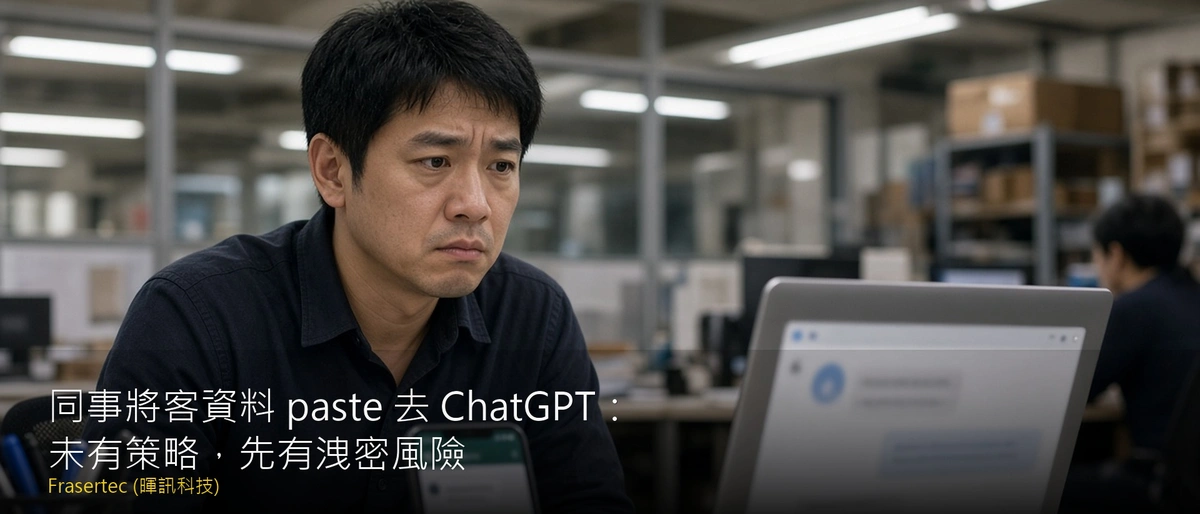
The customer fires off messages in rapid succession on WhatsApp: full contact names, direct mobile numbers, a delivery address at a Tuen Mun industrial building, and photos of two handwritten dockets showing legacy unit prices and item codes. Your sales executive is sitting on four pending quotations with the client pressing hard for an answer. With a quick Ctrl+A and Ctrl+C, the entire WhatsApp exchange gets pasted straight into a free personal ChatGPT account: "Clean this up into a professional English quotation reply." Two minutes later, the draft email looks spotless. But the customer's real name, location, and commercial purchasing history have already left your office network, uploaded onto a public cloud model for training.
A polished reply takes under three minutes to generate, but your customer's identifiable data and commercial terms have already left corporate perimeter controls.
When management spots this, the immediate reflex is often taping a printed notice to an office pillar reading "Strictly No Customer Data in AI Tools", or issuing a stern intranet memo. Yet inquiry volumes never drop and clients continue chasing. Typing a complex response manually takes thirty minutes; pasting it into AI takes ten seconds. A paper policy alone will not stop rushed teams—staff simply switch to incognito windows or paste text on personal handsets before emailing the output back to their workstation.
Staff can draft with AI inside a controlled company environment.
Under the Hong Kong Personal Data (Privacy) Ordinance (PDPO), data users must take all practicable steps to protect personal data against unauthorized access or processing. Free public ChatGPT interfaces retain input data for model training by default; the moment staff paste raw records, a data exposure risk is created. To give teams generative speed while safeguarding customer privacy, you need governed technical architecture rather than unenforceable blanket bans. Frasertec Limited provides AI consulting services that help Hong Kong enterprises implement network boundaries and automated data redaction workflows.
Keep raw client threads out of consumer tools: Configure technical controls and content-filtering rules that detect and block Hong Kong ID numbers, phone details, and physical addresses from flowing into public models.
Redact and draft within governed architecture: Route queries through dedicated enterprise API instances or secured environments where personally identifiable information is masked before drafting, ensuring prompts are not harvested for vendor training.
Retain human oversight and final sign-off: Pricing schedules, delivery terms, and product specifications generated by AI models must be validated by the accountable handler prior to dispatch, preventing commercial disputes caused by hallucinations.
Want faster quotes without sending customer data to a public chatbot? WhatsApp 852 25788828 to start a proof-of-concept (POC) for a controlled enterprise AI workflow.
Book a Discovery SessionWhatsApp 852 25788828FAQ: Does Frasertec's AI consulting service constitute legal compliance advice?
Our work centers on IT systems design, network data flow controls, and technical implementation to align operations with technical privacy safeguards such as the PDPO. We provide technological solutions rather than formal legal counsel. For specific litigation or statutory compliance interpretations, consult a qualified legal practitioner.
FAQ: Why does consumer ChatGPT present a greater operational hazard than an enterprise API?
Consumer-tier terms routinely permit prompt retention for public model retraining, meaning sensitive commercial data can resurface in unexpected outputs. Certified enterprise APIs and dedicated cloud tenants operate under strict agreements prohibiting training on your payload, keeping proprietary data within corporate boundaries.