
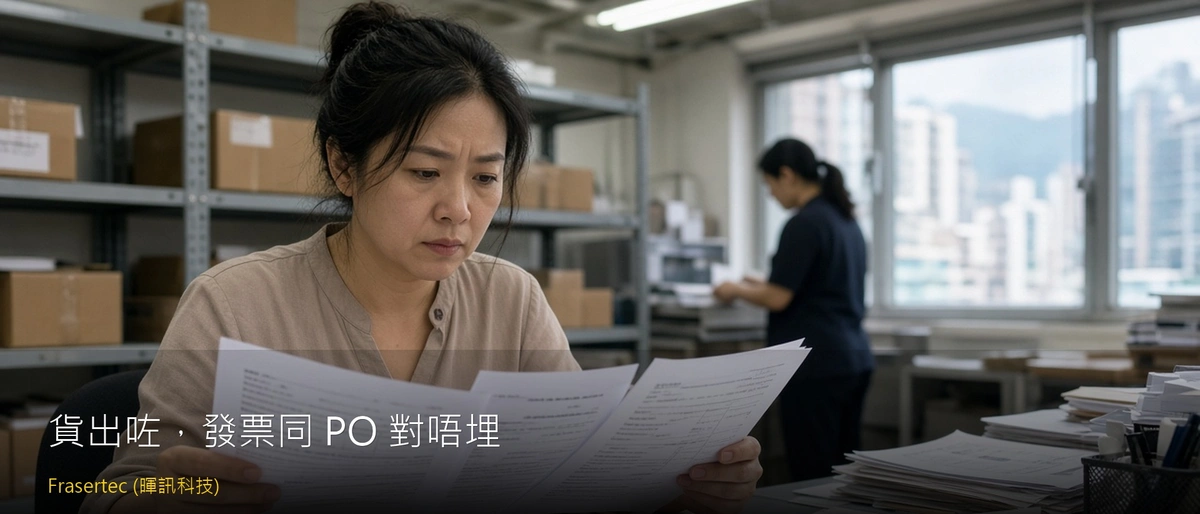
"Your invoice is off by two lines from our PO, and the quantities don't match. We can't approve this payment this month." Monday morning at 10 AM, a client drops that WhatsApp screenshot into the chat, and the phones in sales and accounts start ringing immediately. Four delivery vans dropped off the stock last Thursday, and the client's warehouse already signed the delivery notes. But the moment accounts tries to match the billing, the entire payment gets stuck in approval limbo.
The delivery note follows the warehouse SKU and carton count, the invoice follows the old quote in pieces, and the client's PO follows their internal part codes. Every department re-keys from a different sheet, leaving accounts to catch mistakes line by line. Real operations do not fix this by telling staff to be more careful; they lock the confirmed order as the single source of truth so delivery notes and invoices reconcile automatically.
Why Invoices and POs Fall Out of Sync After Delivery
Unit conversions calculated in someone's head: boxes versus pieces
Sales books by unit, the client's PO specifies packs of twelve, and the warehouse tracks master cartons for loading. Accounts sits with a calculator while cross-referencing the signed delivery note. One misplaced decimal place on an uneven pack size, and the whole invoice bounces against the client's PO.
Competing part numbers: old internal codes clash with supplier barcodes
Sales still uses their personal desktop Excel code, warehouse staff scans the manufacturer barcode on the box, and the client's procurement department insists on their own item code. Everyone assumes the other party understands the shorthand. Once the invoice goes out, a single mismatched character prompts procurement to reject the document entirely.
Last-minute truckside changes trapped in WhatsApp
Half an hour before dispatch, the client sends a quick WhatsApp message asking to pull two items. The sales rep replies "Noted" and calls the loading bay. The warehouse scratches two lines off the paper delivery note, but accounts never gets the message. The original invoice is issued, instantly creating a two-line discrepancy against what was actually received.
Adding Another Reconciliation Sheet Only Creates Another Ignored Excel File
Management's default reaction is often to mandate another shared reconciliation spreadsheet, requiring warehouse, sales, and accounts to tick boxes and sign off before dispatch. On the ground, the warehouse supervisor is busy moving pallets onto trucks and has no time to boot up a PC. At month-end, accounts faces payment pressure and resorts to printing all three papers, tracing lines with highlighters late into the evening. The tracking sheet becomes empty bureaucracy, overtime mounts, and client dispute calls still arrive every week.
Implementing Three-Way Matching: Invoicing Follows Delivery and Orders
Through Frasertec Limited's workflow automation solutions, businesses establish a single source of truth. Delivery notes and invoices are generated directly from the confirmed order, allowing companies to retain their existing accounting software intact.
Lock confirmed orders as the sole baseline
Once the client confirms the quote and purchase order, the system locks product codes, conversion ratios, and unit prices as canonical data. It maps client item numbers to internal stock codes automatically, eliminating redundant re-entry across departments.
Warehouse logs actual dispatch against the order
Delivery notes pull live data directly from the confirmed order. Warehouse staff simply verify physical inventory and update fulfilled quantities. If a shipment is split or items are short, the system logs actual dispatch numbers immediately without relying on verbal handoffs.
Invoices generate automatically from dispatch records
The system automatically reconciles the client PO against signed dispatch records to produce accurate invoice line items. This data syncs cleanly into your existing accounting software, ensuring the billing matches what the client ordered and received down to the penny.
Three Practical Steps to Automate Invoice and Order Alignment
Document sample paperwork and data mapping rules
Assemble a representative client PO, warehouse delivery note, and sales invoice. List recurring unit conversion ratios, cross-reference item codes, and note common patterns for last-minute order revisions.
Schedule a 30-minute workflow review
Meet with a Frasertec Limited consultant online to map data handoffs between sales orders, warehouse dispatch, and invoice generation, identifying exactly where manual cross-checking burns the most hours.
Launch a targeted proof-of-concept (POC)
Select the single product line with the highest transaction volume or error rate. Deploy system configuration and live validation within two to four weeks, without replacing existing accounting platforms.
Stop Waiting for Clients to Flag Invoice Discrepancies
Frasertec Limited helps SMEs streamline order fulfillment data and automate alignment between purchase orders, delivery notes, and invoices—while keeping your existing accounting setup intact. Contact us to schedule a free 30-minute consultation.
Book a Discovery SessionWhatsApp 852 25788828Frequently Asked Questions
Our accounting software has been in place for years. Does workflow automation require a complete replacement?
No. Workflow automation targets data alignment and validation across quotes, orders, delivery notes, and billing. Verified billing records can be exported or pushed via API into your existing accounting system, keeping core financial infrastructure unchanged.
How long does it take to implement a three-way matching workflow?
Focusing on a core fulfillment and billing workflow as a pilot, data mapping, integration setup, and testing typically take between two and four weeks before going live.
Further reading: previous post The Customer Is Chasing a Quote on WhatsApp. You Are Still Copying the Price List.