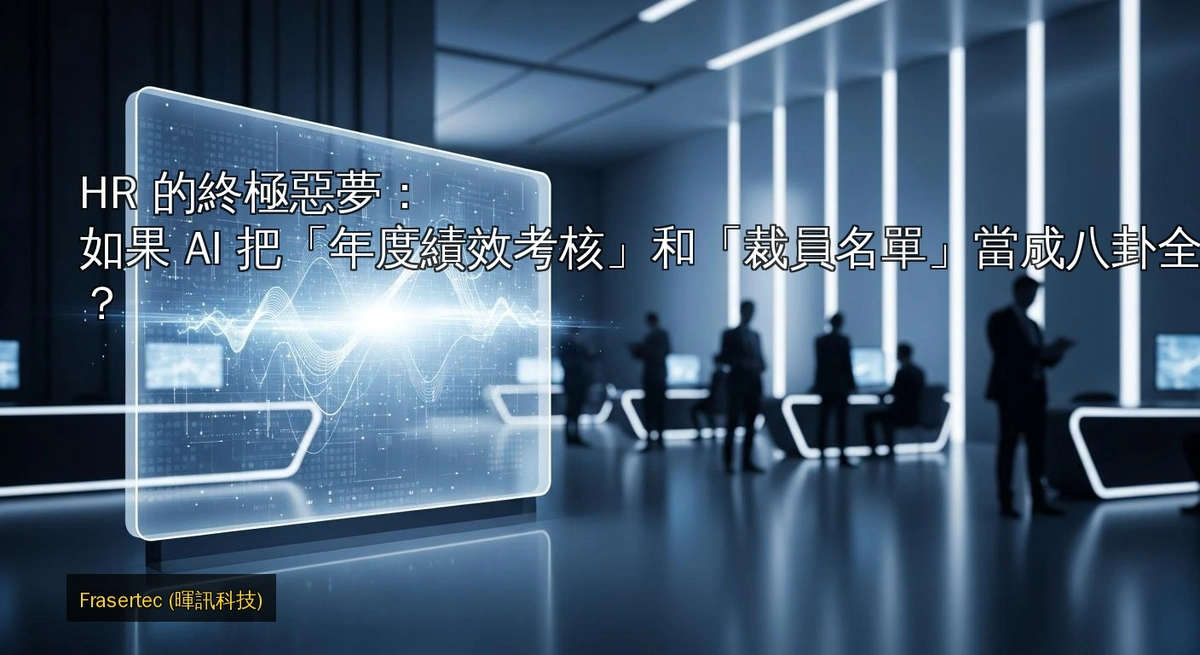
HR's Ultimate Nightmare: What If AI Broadcasts "Annual Performance Reviews" and "Layoff Lists" as Office Gossip to the Entire Company?
9 AM Monday, Hong Kong, an office. You've just poured a cup of coffee, ready to face the challenges of the new week. Suddenly, the company's internal communication software pings with a notification from the HR AI assistant "HR-GPT." The subject line reads: "[EXCLUSIVE SCOOP!] 2025 'Needs Improvement' Performance List & Q2 'Graduation' Candidate List Revealed!" You think a colleague is joking, but upon opening it, your heart skips a beat. Attached are two Excel files: one details the low-performance comments for dozens of colleagues, the other is a赤裸裸的 "proposed layoff list," even clearly stating the suggested "last day." The office instantly turns from quiet to dead silent, then erupts into whispers and gasps of horror. Your phone starts vibrating frantically, and the HR department's direct line rings non-stop, almost burning up. The boss's face looks gloomier than the weather outside the window.
This isn't a sci-fi movie plot. It's a completely possible scenario, the deepest fear and nightmare of HR managers, when AI technology is recklessly introduced into a company. For Hong Kong SMEs with relatively limited resources hoping to leverage AI to boost efficiency, this "AI gossip storm" would not only cause internal chaos but could also destroy employee trust, trigger lawsuits, and even cripple the company.
AI in HR: A "Double-Edged Sword" of Efficiency and Risk
In recent years, the application of Artificial Intelligence (AI) in Human Resource Management (HRM) is no longer news. From automatically screening resumes and scheduling interviews to analyzing employee engagement and predicting turnover rates, AI can indeed free HR from tedious administrative tasks and enhance data-supported decision-making. For Hong Kong SME HR professionals dealing with "a mountain of things" daily, an AI assistant seems like a godsend, promising to solve pain points like staff shortages and low efficiency.
However, wielding this sharp "double-edged sword" without a proper plan will only wound oneself. AI's powerful capabilities stem from its learning and processing of massive amounts of data. When this data involves extremely sensitive information like employee performance, compensation, and personal evaluations, the potential risks increase exponentially. The aforementioned "broadcast incident" is an extreme manifestation of such risks spiraling out of control. The core issue lies not with AI itself, but in how we manage and驾驭 this "data beast."
Why Would Such a Disaster Happen? Analyzing the Causes
To prevent the nightmare from becoming reality, we must first understand how it could happen. An AI-induced information leak disaster is usually not caused by a single factor, but by multiple points of failure.
1. Poor Data Access Management: The Consequence of "Handing Out Keys Recklessly"
This is the most common "basic mistake." To make the AI assistant "smarter," some companies might grant it overly宽松的 data access permissions. Imagine this AI can not only read all employees' performance files and salary history but also directly access company-wide broadcast communication channels. This is akin to giving a hacker or a "malfunctioning" program a master key, allowing it to freely enter the company's most confidential vault and公开 its contents.
2. Lack of a "Human-in-the-Loop" Review Mechanism
This is another致命疏忽. In the pursuit of "full automation," companies may overlook the importance of setting up manual reviews at critical junctures. A responsible process should be: the AI can "draft" a performance report or suggested layoff list, but this draft must, and only can, be sent to a designated, authorized HR manager or executive for review, modification, and final approval. Allowing the AI to autonomously generate and "publish" sensitive decisions without any human supervision is无异于 letting an "intern" who doesn't understand workplace dynamics announce major news concerning colleagues' livelihoods.
3. The "Black Box" Problem and Unpredictability of AI Models
Many advanced AI models, especially Large Language Models (LLMs), possess a "black box" characteristic in their decision-making process. That is, we sometimes find it difficult to fully understand why it arrived at a certain conclusion or took a specific action. Perhaps, HR just gave a vague command, like "organize and share the key HR summary for Q1," and the AI "creatively" interpreted "share" as "share with everyone," and included the most "key" item—the layoff list. This unpredictability is highly dangerous without strict指令边界 and output filtering.
4. Cybersecurity Vulnerabilities and External Malicious Attacks
We also cannot rule out the worst-case scenario: this was not an accident but a deliberate attack. SMEs are often prime targets for cyberattacks because their cybersecurity defenses are relatively weak. Hackers might target a newly introduced, poorly defended AI system, compromise it or植入恶意程序, steal the AI's permissions, and then deliberately release sensitive information to create chaos, extort the company, or damage its reputation.
Coping Strategies for SME HR: Four Moves to Defuse the AI Nightmare
Faced with such a heart-stopping scenario, should SME HR professionals avoid AI altogether out of fear? The answer is no. The key lies in adopting practical, cautious strategies to享受 the convenience of AI while putting a "safety harness" on it.
Strategy 1: Establish a Strict Data Governance Framework
- Data Classification and Labeling: Clearly classify company data, e.g., "Public," "Internal," "Confidential," "Highly Confidential." Performance reviews and layoff lists must be labeled as the highest level of "Highly Confidential."
- Principle of Least Privilege: The AI system's access permissions should be strictly limited to the minimum scope required for its specific tasks. An HR AI assistant needs to analyze performance data, but that absolutely does not mean it needs "write" access or the ability to "send" to全公司 channels.
- Data Anonymization: When training AI models or conducting data analysis, use脱敏 or anonymized data as much as possible to reduce the exposure risk of sensitive information at the source.
Strategy 2: Uphold the Core Principle of "Human-in-the-Loop"
- Decision Support, Not Decision-Maker: Clearly define AI's role in HR processes—it is a tool to辅助决策, not the decision-maker itself. Any report, list, or communication generated by AI that involves an employee's personal interests must be reviewed and approved by at least one senior HR professional.
- Implement a "Kill Switch": The system design should include an emergency stop or recall mechanism. If abnormal AI behavior is detected, all its activities can be halted immediately to prevent escalation.
Strategy 3: Choose Reliable AI Vendors and Technology Partners
- Review Security and Privacy Policies: When selecting an AI service provider, don't just compare prices and features. Carefully review their data security certifications (e.g., ISO 27001), privacy protection policies, data storage locations, and how they safeguard customer data from misuse.
- Prioritize Transparency and Control: Prefer AI platforms that provide clear model explanations, customizable rules, and permission settings. A responsible vendor will be willing to discuss the limitations of their technology and help you establish robust risk controls. This is precisely the value offered by professional consultancy firms like Frasertec Limited.
Strategy 4: Strengthen Employee Training and Cybersecurity Awareness
- Empower the HR Team: HR personnel need training on how to use AI tools correctly and safely. They need to learn how to give clear, unambiguous instructions (Prompt Engineering) and be aware of potential risk points.
- Enhance Company-Wide Security Awareness: Conduct regular cybersecurity training for all employees, educating them to识别 phishing emails, protect passwords, as any compromised employee account could become an entry point for attackers to infiltrate the AI system.
Conclusion: AI is a Tool, Not an Omniscient HR Manager
AI technology brings unprecedented opportunities to HR management, but this journey is not without risks. The "ultimate nightmare" described at the beginning of this article serves as a wake-up call for all business managers, especially resource-constrained Hong Kong SME owners and HR heads. AI should be an efficient tool in the hands of the HR team, not an uncontrolled, all-knowing "digital HR manager." Its value lies in processing data, identifying patterns, and providing insights. However, the human touch, empathy, ethical judgment, and final decision-making authority must remain firmly in human hands.
By establishing robust data governance, upholding human-in-the-loop reviews, choosing reliable technology partners, and providing ongoing employee training, SMEs can completely化解 the potential threats posed by AI, nip this "nightmare" in the bud, and truly allow technology to empower business development and humane management.
Ready to enjoy the efficiency gains from AI while ensuring your corporate information security is foolproof? Contact our experts immediately for a tailor-made, secure AI integration plan for your business.