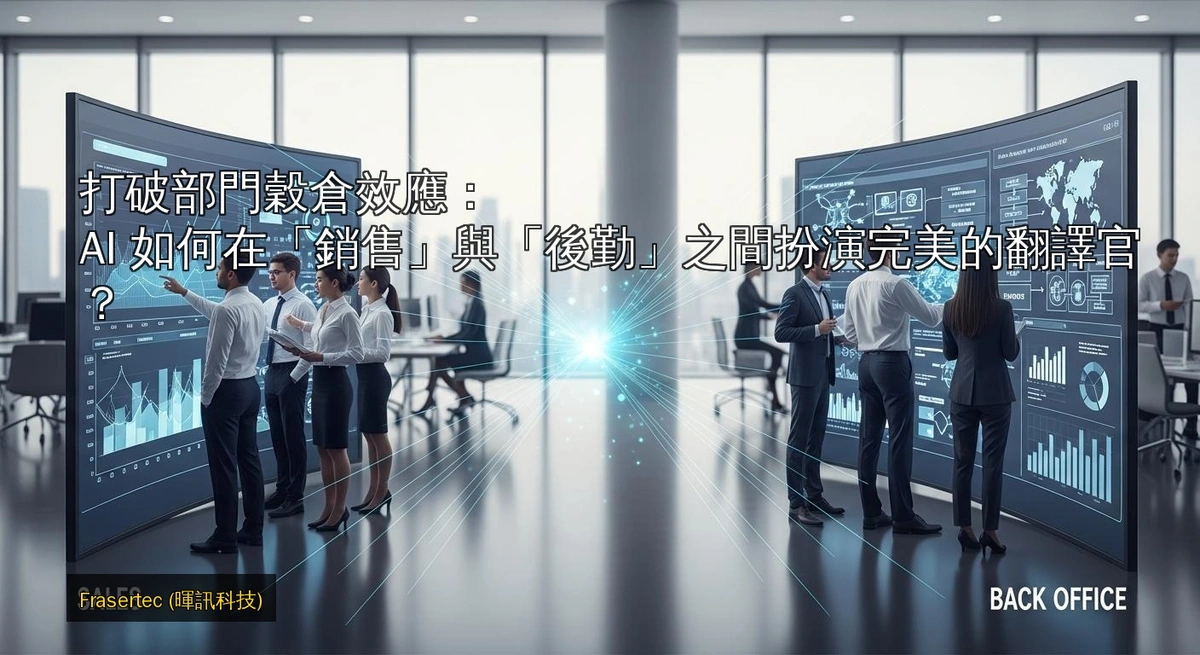
Breaking Departmental Silos: How Can AI Perfectly Bridge the Gap Between 'Sales' and 'Logistics'?
Common in Hong Kong SMEs, the "Departmental Silo Effect" often leads to a communication breakdown between sales and back-office teams, severely impacting efficiency and customer satisfaction. Frasertec analyzes how AI serves as a "translator," integrating sales forecasts with inventory data in real-time to turn front-line promises into actionable back-office solutions.
The "Silo" Struggle: A Daily Reality for HK SMEs
"Don't worry, it will definitely be delivered tomorrow!" a front-line salesperson promises a client to close a deal. Meanwhile, in the warehouse, the logistics team looks at a mountain of orders and congested delivery routes, sighing: "They promised it again without checking if we can actually do it!"
This scenario is a microcosm of the daily challenges faced by many Hong Kong SME owners. Sales and Logistics should be the left and right hands of a business, but they often operate behind invisible walls due to mismatched goals and disconnected data. This is the Departmental Silo Effect. Sales focuses on relationships and targets; Logistics focuses on costs and punctuality. When they speak "different languages," the company’s profit and customer trust are the ultimate sacrifices.
In the wave of digital transformation, Artificial Intelligence (AI) is stepping in as the long-awaited "perfect translator" to bridge this gap.
The Cost of Silos to Your Business
In Hong Kong’s high-speed, high-cost business environment, the Silo Effect is more than just a minor friction—it is a systemic drain on competitiveness:
- Resource Misallocation: Sales runs a massive promotion without informing Logistics, leading to stockouts and emergency shipping costs.
- Declining Customer Experience: Over-promising and under-delivering is the fastest way to lose a client in the age of social media.
- Data Islands: When sales trends and inventory costs aren't synced, management is "flying blind" regarding pricing and planning.
- Internal Conflict: Constant finger-pointing between "unrealistic sales" and "uncooperative back-office" destroys team morale.
AI as the Translator: Turning "Sales Talk" into "Back-office Instructions"
AI’s power lies in its ability to process data 24/7, translating front-line intuition into precise operational commands.
1. From "Sales Gut Feeling" to "Precision Forecasting"
Traditionally, sales teams predict demand based on "feel." AI replaces this with data. It integrates historical sales, CRM behavior, and external factors (like weather or public holidays).
- The Translation: Instead of "I think blue bottles will sell well," AI tells Logistics: "Expect a 45% surge in demand for Blue Water Bottles (SKU: WB-BL-500) in Kowloon over the next two weeks. Move 500 units to the Cheung Sha Wan hub now."
2. From "Real-time Orders" to "Dynamic Routing"
When a sale is made, it’s not just a transaction; it’s a logistics signal. AI captures new orders instantly and maps them against traffic conditions and vehicle capacity.
- The Translation: Sales no longer sees "Processing" in the system; they see "Assigned to Driver Mr. Chan, estimated delivery 3:00 PM - 5:00 PM."
Two-Way Communication: Turning "Logistics Limits" into "Sales Opportunities"
A good translator works both ways. AI feeds back-office constraints back to Sales to create smarter strategies.
1. Real-time Inventory Visibility
AI syncs live inventory levels directly to the Sales CRM or POS.
- The Benefit: Sales can see exactly what is in the Hong Kong warehouse (ready for same-day delivery) versus the Shenzhen warehouse (2-3 days lead time). This prevents "empty promises" and allows Sales to guide customers toward items currently in stock.
2. Turning Logistics Costs into Dynamic Pricing
Shipping to remote areas (like Outlying Islands) costs more. AI calculates these costs in real-time.
- The Benefit: If a delivery cost is high, the AI can prompt the customer: "Add $100 more to your order to qualify for free shipping," or suggest to Sales: "Consolidate Tung Chung deliveries to Saturdays for a 10% discount." This turns a logistics pain point into a sales incentive.
How SMEs Can Deploy Their "AI Translator"
Deploying AI is no longer a futuristic fantasy. Hong Kong SMEs can start with these steps:
- Integrated Data Platforms: Use modern cloud systems that link CRM (Customer Relationship Management) and ERP (Enterprise Resource Planning).
- AI-Driven Inventory Management: Use software that suggests restocking levels based on automated trend analysis.
- Smart Routing Tools: Replace manual scheduling with AI route optimization to save fuel and time.
- Internal AI Chatbots: Build a knowledge base where Sales can instantly ask a bot about stock levels or delivery statuses.
About Frasertec (暉訊科技)
With 20 years of experience in the Hong Kong IT market, Frasertec specializes in "Deep Digital Migration." We don't just develop software; we redesign your business processes to be AI-driven.
- 20 Years of Experience in HK IT Services.
- 100+ Successful Transformation Cases.
- 40% Average Increase in Efficiency.
- Local Professional Support based right here in Hong Kong.
Ready to break down your departmental silos?
Message us on WhatsApp for a Free Deep Assessment (30-minute consultation + detailed report).
WhatsApp: 852 25788828
Frasertec – Your Partner from Traditional Operations to AI-Driven Intelligence.