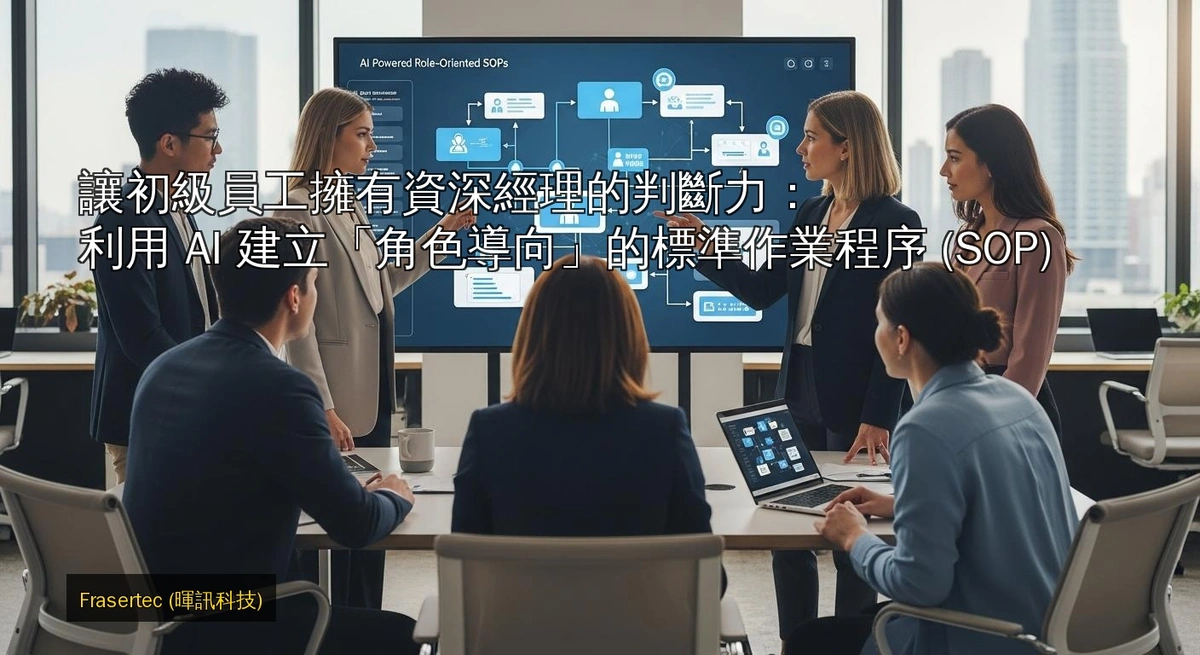
Empowering Junior Staff with Senior Manager Judgment: Using AI to Build "Role-Oriented" Standard Operating Procedures (SOP)
Empowering Junior Staff with Senior Manager's Judgment: Building 'Role-Oriented' Standard Operating Procedures (SOP) with AI
A Must-Read for Hong Kong SME Owners! Traditional SOPs are outdated and cannot cope with a dynamic market. This article explores how to use AI Rapid Development to build 'Role-Oriented' SOPs, replicating the judgment of senior managers for junior staff. This addresses pain points like talent loss and inconsistent service, helping you free up management time to focus on business growth.
As a Hong Kong SME boss, are you often troubled by the following scenarios?
- "Boss, what should I do about this situation?" — A new junior employee is at a loss when faced with a slightly complex customer inquiry, and ultimately you have to step in personally.
- "Now that John's left, no one knows how to handle these things." — Once your most capable senior manager leaves, the valuable experience and adaptive skills in their mind leave too, causing gaps everywhere during the handover.
- "Why was it handled that way last time, but differently this time?" — Different employees handle the same problem with different standards, leading to inconsistent service quality and affecting the company's brand image.
The core of these problems points to a long-standing pain point for Hong Kong SMEs: Knowledge and experience are overly concentrated in a few 'old hands' or the boss themselves. We rely on human judgment, but people's time and energy are limited, and they move on. Traditional Standard Operating Procedure (SOP) documents—those thick files and long PDFs—often become dust-collecting ornaments because they are rigid and inflexible, unable to teach employees the most valuable thing: Judgment.
But today in 2026, the maturity of AI technology offers us a brand new solution path. It's time to bid farewell to traditional SOPs and step into a new era of smarter, more flexible operations: Using AI to build 'Role-Oriented' Standard Operating Procedures (SOP). This is not just a technical upgrade; it's a revolution in management thinking, aiming to empower your junior staff with the judgment of a senior manager.
Why Do Traditional SOPs 'Not Fit the Soil' in Hong Kong?
Before delving into the AI solution, we must first understand why traditional SOPs are increasingly struggling in Hong Kong's fast-paced business environment. This is precisely a microcosm of the AI dilemma faced by many Hong Kong SMEs.
- Too Static, Unable to 'Adapt on the Spot': Traditional SOPs describe standard processes under ideal conditions, but real-world problems are diverse and strange. When a customer raises an issue not covered by the SOP, or a sudden situation occurs, rigid guidelines offer no help. Employees still need to seek help from superiors, rendering the SOP instantly ineffective.
- Lacks Context, Only Has Instructions: SOPs only teach employees 'what' to do (e.g., Step 1, Step 2), but rarely explain 'why' to do it and 'when' to do it in a specific context. This leads to employees merely following the script, unable to make flexible judgments in different situations.
- Difficult to Update, Information Lags: The market changes, customer needs change, and a company's best practices evolve. Updating a traditional SOP often requires manual revision, re-publication, and re-training—a cumbersome process that quickly causes the document content to fall out of sync with reality.
- Hard to Pass Down 'Tacit Knowledge': The value of a senior manager lies not only in knowing the processes but also in their experience handling emergencies, skills in dealing with difficult customers, and wisdom in balancing various interests... This 'tacit knowledge' is extremely difficult to put into words, yet it is the key to making accurate judgments.
A traditional SOP is like an old map; it can tell you the official route from point A to point B but cannot cope with sudden road closures or traffic jams. What we need is an intelligent navigation system that updates in real-time and suggests the best route. This is the core idea of a 'Role-Oriented' AI SOP.
What is a 'Role-Oriented' AI SOP? It Teaches Not Just 'What to Do', But 'How to Think'
A 'Role-Oriented' AI SOP is essentially a dynamic, interactive corporate knowledge brain. It is no longer a dead document but an intelligent assistant that provides personalized guidance based on the user's role, current context, and real-time data. This is precisely the direction for modernizing Flexible CRM and Enterprise Systems.
Let's use a common 'Handling Customer Complaints' scenario to illustrate the world of difference between a traditional SOP and an AI SOP:
Scenario: A long-term customer calls to complain about a delivery delay, sounding angry.
Traditional SOP Approach:
Junior Customer Service Agent Miss A opens the PDF and sees: 1. Apologize to the customer. 2. Record customer details and complaint. 3. Refer the case to the manager.
Result: Miss A recites the apology like a robot and then throws the problem to the already busy manager. The customer feels the issue isn't resolved and gets angrier. Miss A learns nothing from the experience.
'Role-Oriented' AI SOP Approach:
Junior Customer Service Agent Miss A types "Customer complaint: delivery delay" into the system. The AI system immediately activates:
- Role Identification & Situational Analysis: The system identifies the user as a 'Junior Customer Service Agent' and, by connecting to the CRM system, instantly pulls up the customer's profile.
- Provides Personalized Guidance: The AI assistant offers empathetic phrasing, decision-tree guidance, and knowledge supplements.
- Upward Reporting & Data Accumulation: Automatically generates an incident report; supervisors can view analysis and trends.
See the difference? The AI SOP not only gives Miss A the 'fish' to handle the immediate problem but also teaches her how to think based on customer tier and company policy—this is the 'fishing rod.' It transforms the judgment model in the senior manager's mind (Customer Value > Handling Solution > Cost Control) into an executable framework, empowering junior employees to make confident, correct decisions within their authorized scope.
Four Core Advantages AI SOPs Bring to Hong Kong SMEs
1. Empower Junior Staff, Eliminate 'Single Point of Failure' Risk
Through AI SOPs, every new employee is equipped with a 24/7 virtual mentor. They can get up to speed faster and independently handle more complex tasks. This significantly reduces the company's reliance on any single 'super employee.' Even if personnel changes occur, the core knowledge and judgment standards remain embedded within the system.
2. Ensure Service Consistency, Enhance Customer Experience
When all employees handle problems based on guidance from the same intelligent brain, no matter which staff member a customer interacts with, they receive stable, high-quality service. This consistency is the cornerstone for building customer trust and brand loyalty, and is one of the core objectives of our services.
3. Accelerate Knowledge Accumulation & Transfer
Every interaction and every decision can be recorded and learned by the AI system. Successful handling solutions become best practices for future reference, while lessons from failures are used to optimize processes. The company's wisdom no longer leaves with departing employees but accumulates like a rolling snowball, growing richer over time.
4. Liberate Management, Focus on Core Strategy
When day-to-day operational problems can be effectively handled by the system and junior staff, bosses and senior managers can finally break free from endless 'firefighting' work. They can devote their precious time and energy to more valuable strategic aspects like market analysis, business expansion, and innovative R&D.
How to Take the First Step?
Reading this, you might think it all sounds great, but isn't it complex and expensive? Not necessarily. Building a 'Role-Oriented' AI SOP doesn't require you to achieve everything at once. You can start with a small entry point:
- Start with the Most Painful Process: Choose a business process that currently consumes most of your management time, causes frequent errors, or heavily relies on a specific employee, e.g., quoting, handling complaints, procurement.
- Outline the Senior Manager's Decision-Making Logic: Sit down with your most capable manager and document these valuable judgment logics.
- Choose the Right AI Tools & Partner: Seek assistance from professional consultants like Frasertec Limited. We can help analyze your business processes and transform your 'tacit knowledge' into logic that AI can understand and execute. Learn how our AI Rapid Development saves time and cost.
- Continuously Iterate and Optimize: An AI SOP is a living system. After launch, continuously adjust and enrich its knowledge base based on actual usage and feedback.
Conclusion
In Hong Kong, where labor costs are high and talent turnover
You may also be interested in...

HR's Ultimate Nightmare: What If AI Broadcasts "Annual Performance Reviews" and "Layoff Lists" as Office Gossip to the Entire Company?
This article depicts an HR nightmare scenario: an AI assistant inadvertently broadcasts confidential performance reviews and a layoff list company-wide, causing chaos. This extreme case reveals the severe risks enterprises may face when introducing AI, such as mismanaged data permissions, lack of human oversight, and neglect of cybersecurity. For SMEs, the article recommends navigating AI risks by establishing a strict data governance framework, insisting on "human-in-the-loop" review processes, choosing reliable technology partners, and strengthening employee training. Frasertec Limited reminds us that AI should be an辅助工具, and final decisions involving people must remain under human control to safely enhance efficiency.

Business Department Upheaval? When Colleagues Use AI to Peek at Your "Exclusive Client List" and Bottom Line...
The widespread use of AI tools in offices may allow colleagues to easily steal exclusive client lists and bottom-line quotations, leading to leaks of business secrets. Small and medium-sized enterprises often face risks due to chaotic permission settings, the use of unapproved AI tools, and a lack of data classification. Frasertec Limited recommends three key prevention strategies: implementing the least privilege principle, deploying data leakage prevention solutions, and utilizing user behavior analytics to monitor abnormal activities, thereby protecting core data assets and avoiding losses caused by internal threats.
Spend Half Your Day Chasing Clients and Submitting Documents? Let AI Be Your 'Strongest Secretary', Automatically Tracking Progress Without the Frustration
Hong Kong SMEs often spend excessive time chasing clients for documents, leading to inefficiency and blocked cash flow. This blog introduces how to leverage AI as the "ultimate assistant," using automated workflows to set rules, personalize communication, and analyze data, enabling round-the-clock progress tracking, freeing up team time, and improving client relationships. Frasertec Limited provides professional AI solution consulting to help businesses transform and enhance efficiency.