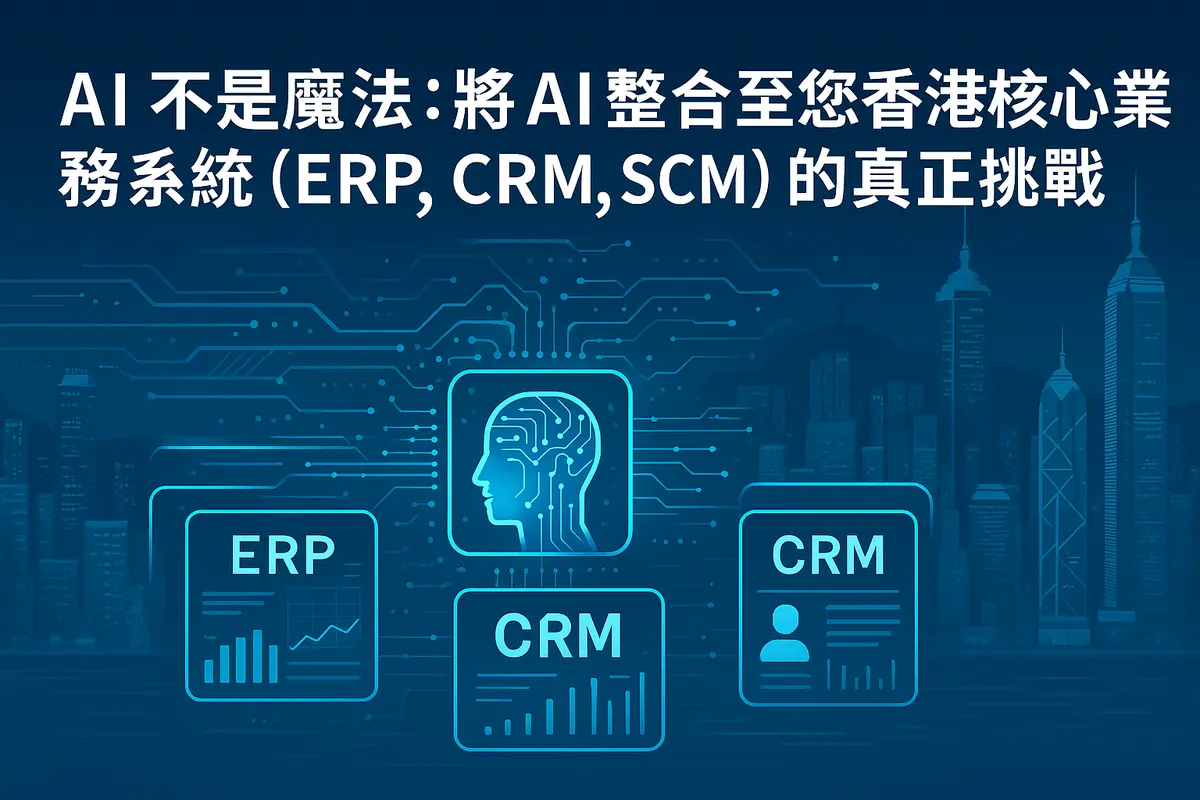
AI Is Not Magic: The Real Challenges of Integrating AI into Your Core Business Systems (ERP, CRM, SCM) in Hong Kong
The True Power of AI Lies in "Implementation," Not Just "Hovering"
The potential of artificial intelligence (AI) is immeasurable—from optimizing operations and enhancing customer experiences to driving innovation, its possibilities seem endless. Many Hong Kong SMEs are eager to adopt AI tools to add value to their businesses. However, a common misconception is that AI tools can work like standalone applications, delivering magical results with a simple "plug-and-play" approach.
In reality, AI is not a magic wand. Its true value does not come from flashy standalone features but from seamless integration with a company's core business data and workflows. Only when AI deeply "understands" the pulse of your business—your customer data, sales records, inventory levels, and supply chain dynamics—can it truly become a powerful engine for growth. Otherwise, even the most advanced AI technology may end up as an expensive "ornament," failing to deliver tangible business returns.
For growing SMEs that have already invested in core business systems (such as ERP, CRM, or SCM), the challenge lies in effectively integrating AI capabilities into these existing systems.
Roadblocks to AI Integration: Common Challenges for SMEs
Integrating AI into existing core systems is often more complex than anticipated. Below are some common obstacles Hong Kong SMEs encounter in practice:
-
Data Silos:
- Challenge: Data across different departments or systems (e.g., sales, marketing, accounting, inventory) operate in isolation, lacking interconnectivity. AI models require comprehensive, unified data for effective analysis and prediction.
- Example: Customer interaction records in a CRM system are disconnected from transaction histories in an ERP system, making it difficult for AI to build a complete customer profile or understand purchasing behavior.
-
Legacy System Compatibility:
- Challenge: Many SMEs still rely on older core systems not designed to interface with modern AI technologies, lacking standardized APIs or data formats.
- Example: A long-standing customized inventory management system may struggle to exchange real-time data with a new AI-driven demand forecasting module.
-
API Limitations:
- Challenge: Even if existing systems offer APIs, their functionality, data extraction frequency, or security constraints may fall short of the deep integration and real-time interaction required for AI applications.
- Example: A cloud accounting software's API may only allow daily batch data exports, while an AI-driven real-time fraud detection system requires more frequent updates.
-
Data Mapping and Transformation:
- Challenge: Data structures, field definitions, and formats may vary across systems. Integration demands significant effort in data mapping, cleansing, and transformation to ensure consistency and accuracy.
- Example: Product numbering rules in an ERP system may differ from product IDs in an e-commerce platform, requiring clear mapping rules for AI to correctly identify the same product.
-
Data Security During Integration:
- Challenge: When bridging data flows between systems, ensuring data security during transmission and processing is critical to prevent leaks or unauthorized access—especially for sensitive customer and financial data.
- Example: Synchronizing CRM data to an AI analytics platform requires encrypted transmission and strict access controls.
Why Overcome These Challenges? The Rewards of Deep Integration
Despite the challenges, the benefits of successful deep AI integration are immense, transforming AI from an "add-on" into a core business asset:
- Truly Automated End-to-End Processes: AI no longer handles isolated tasks but orchestrates complex workflows across multiple systems. For example, AI can generate production orders in an ERP system based on sales forecasts from a CRM and trigger material procurement in an SCM system.
- Unified Data Views for Better AI Analysis: Breaking down data silos enables AI to analyze more comprehensive and consistent data, yielding deeper insights and more accurate predictions—such as precise customer churn warnings or market trend assessments.
- Better Decisions Based on Real-Time Data: When AI can access and analyze the latest data from core systems in real time, business leaders can make smarter, timelier decisions.
- Improved Operational Efficiency and Cost Reduction: Automated workflows and optimized resource allocation (e.g., AI-driven inventory management or logistics routing) significantly boost efficiency, reduce human errors, and lower operational costs.
Strategic Integration Approaches: Choosing the Right Path
Depending on integration needs and existing system conditions, businesses can consider the following strategic approaches:
- Custom API Development: If existing systems lack sufficient APIs or their functionality is inadequate, custom APIs can be developed to facilitate data exchange.
- Middleware: Middleware acts as a "bridge" or "translator" between systems, handling data format conversions and communication protocol matching to simplify point-to-point integration.
- Platform Integration: Modern core business systems often offer better openness and integration capabilities, making it easier to connect with third-party AI services or modules.
- Phased Integration: For complex projects, a phased implementation strategy—starting with the most critical, high-impact areas—can gradually expand integration scope.
Frasertec Limited's Expertise: Bridging AI Potential and Reality
Transforming AI's vast potential into tangible competitive advantages hinges on effective system integration. Frasertec Limited brings deep expertise in system integration and custom software development, helping Hong Kong SMEs overcome AI integration challenges:
- In-Depth System Assessment and Integration Planning: Our [Technical Consulting Services] begin by thoroughly understanding your core business systems, data landscape, and AI goals, crafting the most suitable integration blueprint.
- Breaking Down Data Silos: We excel at integrating data across systems—whether through API connections, database synchronization, or middleware solutions—to establish unified data views.
- Custom Development for Seamless Embedding: Our [Custom Software Development Services] tailor AI modules to your needs, embedding them seamlessly into your ERP, CRM, or SCM systems to ensure tight alignment with your workflows.
- Ensuring Stability and Security: We prioritize system stability and data security during integration, adhering to industry best practices to protect your core assets.
- AI as a Core Operational Asset, Not a Gimmick: Our goal is to ensure AI solutions address real business pain points, enhance efficiency, and become indispensable—not just fleeting tech demonstrations.
Facing Integration Challenges? Let Experts Help!
If your business plans to adopt AI but feels uncertain about integrating it with existing core systems, don’t hesitate. While AI integration poses challenges, they can be overcome with the right technical partner.
Contact Frasertec Limited today to schedule a free [Integration Assessment Consultation]. Our expert team will listen to your needs, evaluate your systems, and provide professional, practical AI integration advice to help you harness AI’s power and achieve business breakthroughs.